
ABA Therapy Hours: How Much ABA is Enough
Written by Behavior Frontiers as part of their ABA Success Series

ABA Therapy Hours: How Much ABA is Enough
If your child has been recommended for ABA therapy, you're already taking one of the most important steps you can take for their future. And if the number of hours recommended (typically 26 to 40 hours a week) feels surprising, you're not alone.
Many families feel the same way at first. But here's what we've seen time and time again: those hours are where the magic happens. They're where kids find their voice, make their first real friendships, discover what they're capable of, and build the foundation for a lifetime of growth.
Think of it this way: when a doctor prescribes a specific dosage of medication, that number isn't random. It's carefully chosen based on your child's needs, the latest research, and what will give them the best chance of meaningful progress.
ABA therapy hours work the same way. The intensity recommended for your child is thoughtfully determined by a licensed clinician. It's not as a one-size-fits-all prescription, but as a personalized plan built around who your child is, what their opportunities are, and what they need to make progress that lasts.
You might still be wondering:
Why so many hours?
Is that really necessary?
What will my child be doing all that time?
These are important questions. And we want you to know, when it comes to ABA therapy, no hour is wasted. Intensity of hours is based on research, clinical best practices, and evidence-based approaches we know will help your child succeed.
What Does “High-Intensity” ABA Therapy Mean?
High-intensity ABA therapy means your child receives 26–40 hours of one-on-one therapy per week, typically in a center-based environment. These hours may sound like a lot, but they're thoughtfully structured to support steady progress.
So, if you’re picturing 40 hours of your child sitting at a table doing drills and procedures, you have the wrong picture. Think more along the lines of engaging, play-based learning.
It will include:
One-on-one skill-building with a behavior technician
Group activities with peers to practice social skills
Sensory breaks and movement activities for emotional regulation and gross motor skills
Mealtime and self-care routines
Music, dramatic play, and creative exploration
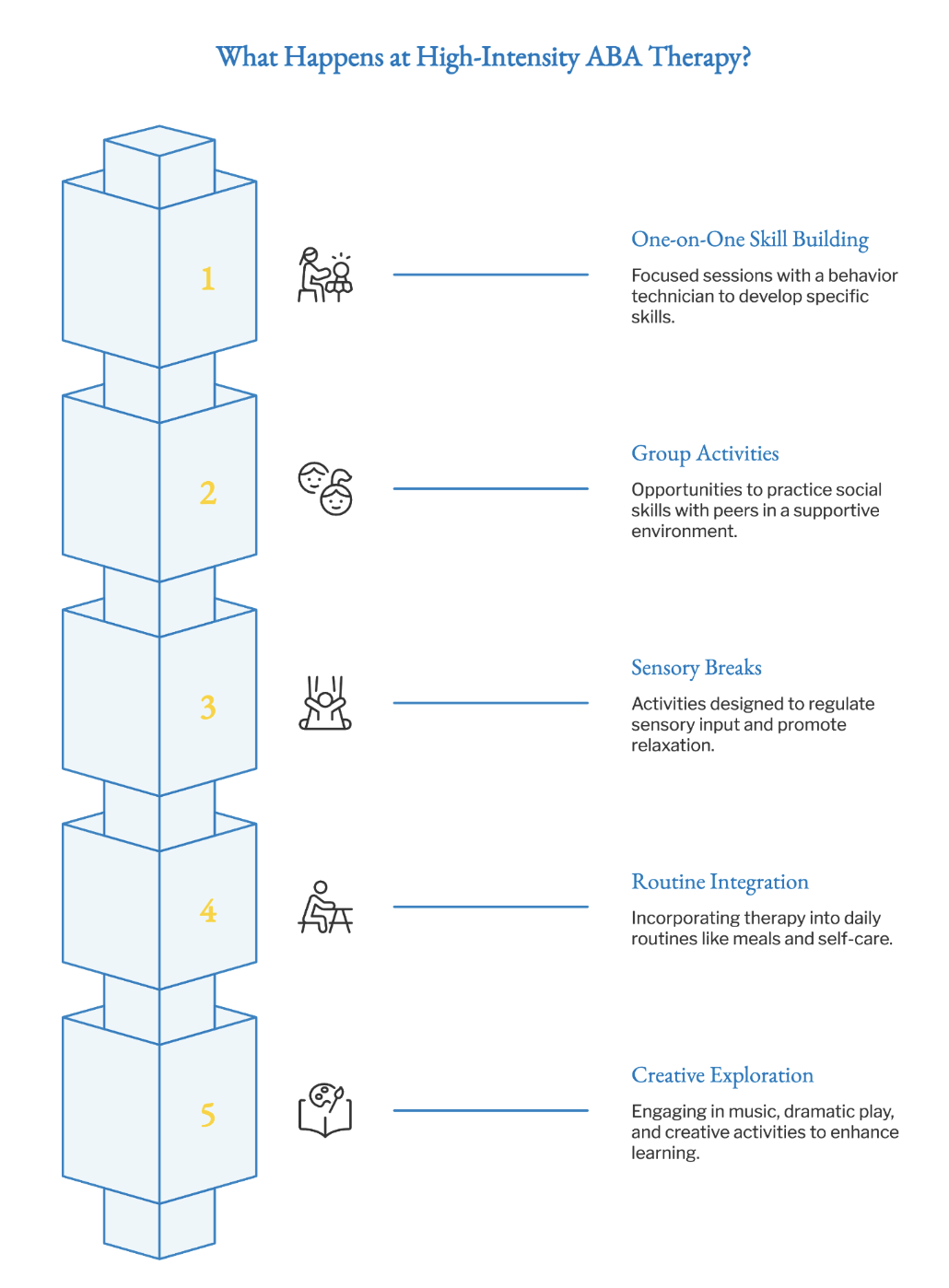
What happens at high-intensity ABA therapy?
Every hour is intentional, and every activity has a purpose. And because the therapy happens in a dedicated center with specialized resources and expert oversight, your child has access to learning opportunities that might not be available at home.
How Many Hours of ABA Therapy Are Needed?
The number of hours may vary by child.
Age and developmental stage: Younger children (under age 6) often benefit most from intensive early intervention, as their brains are especially adaptable during this window.
Severity of behaviors: Children with more significant communication, social, or behavioral challenges may need more intensive support to build foundational skills.
Individual goals: Some children need more support across multiple skill areas (communication, social interaction, daily living, play). Others may need more focused intervention on specific skills.
Clinical assessment: Your child's Board Certified Behavior Analyst (BCBA) will conduct a thorough assessment and recommend the intensity that best supports your child's needs and goals.
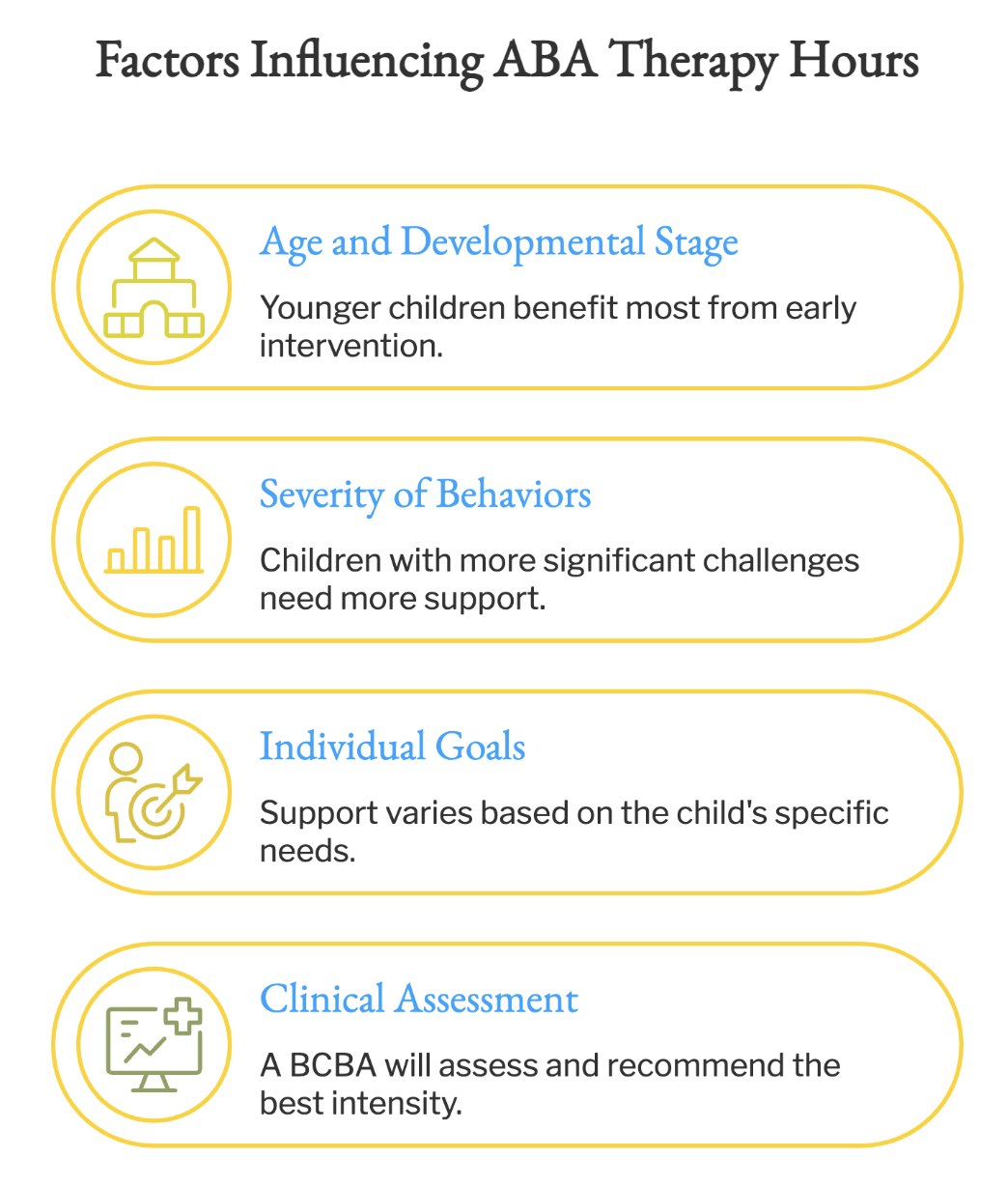
Several factors impact the intensity of ABA therapy hours.
The goal is always to provide enough intensity to support meaningful progress and lasting outcomes. High-intensity programs are designed to give children the best possible start.
How Are Hours Determined?
The recommended hours are based on:
Functional Behavior Assessment (FBA): A careful process of observing your child, gathering data, and understanding their current skills, challenges, and needs.
Clinical guidelines and research: Decades of research show that higher intensity leads to better outcomes, especially for comprehensive early intervention.
Family input: You know your child better than anyone. We work closely with you throughout the process to make sure we're building the most effective plan possible. We work to understand what motivates your child, and sure we're not overlooking details that could make a difference in their progress.
Ongoing progress monitoring: Your child's plan is never set in stone. As they grow and hit new milestones, their BCBA will continuously review and adjust their program to make sure every session is as effective as possible. And we'll collaborate with you every step of the way.
Consistency Matters: Why Showing Up Makes All the Difference
While the number of hours your child receives is based on their needs and clinical guidelines, the impact of those hours depends heavily on consistency.
Just like skipping a prescribed dose of medication can slow progress, missing therapy sessions can interrupt learning and make it harder for children to build on their developing skills. ABA works best when therapy is delivered regularly, without long gaps between sessions.
Reasons why consistency works:
Each session builds on the last: Skills are taught gradually and reinforced over time. When sessions are missed, momentum is lost, and children may need to re-learn skills that were just starting to stick.
Routine supports engagement: Many children with autism thrive on predictability and structure. A steady schedule helps them feel safe, focused, and ready to learn.
Fewer missed sessions = stronger results: Even one or two missed appointments per month can reduce overall therapy effectiveness.
It's one of the most powerful ways families support growth: Showing up (even on tough days) makes a real difference. Your commitment to consistency is just as important as ABA therapy itself.
Why High-Intensity Works: The Research to Back It Up
You might still be asking: Does high-intensity therapy really make that much of a difference?
The short answer is yes. And research supports it.
Analyses summarized by the Association of Professional Behavior Analysts, drawing on data from 341 children in ABA programs, show that children receiving high‑intensity treatment (26–40 hours per week) demonstrate the greatest gains in cognition, adaptive behavior, and reductions in autism severity.
Compared to low-hour therapy plans, children in high-intensity programs showed:
+22 IQ points (vs. +11 with low hours)
+9 points in adaptive living skills like self-care and communication (vs. +2 with low hours)
-11 points in autism severity (vs. -6 with low hours)
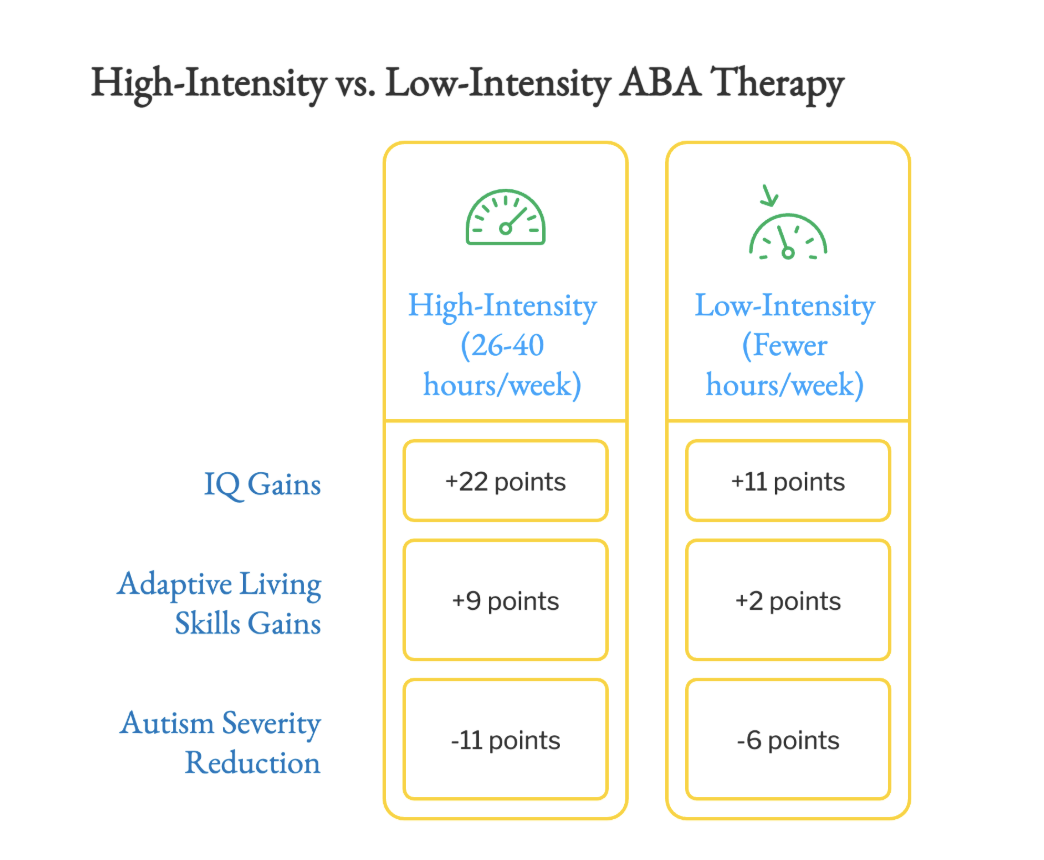
High-intensity ABA therapy hours are more effective overall.
Children in high-intensity programs were more likely to improve their independence, participate in everyday routines, develop stronger social and communication skills, and be placed in general education settings.
Other research supports this, too. Studies consistently show that:
More hours = more progress, especially in early intervention
Comprehensive programs addressing multiple skill areas lead to better long-term outcomes
Intensive ABA during critical developmental windows (ages 2–6) can significantly alter a child's growth
At Behavior Frontiers, we take this even further with our proprietary PrioraCare™ platform. We built PrioraCare™ because we believe real-time decisions lead to better outcomes. Rather than relying on manual data collection and after-the-fact analysis, PrioraCare™ captures and aggregates progress live. This way, our clinicians can make faster, more precise adjustments and ensure every session counts.
What High-Intensity Therapy Looks Like in Practice
By now, you have a pretty good picture of what goes into a high-intensity ABA program. Here's what a typical week at a Behavior Frontiers autism care center could look like:
Monday–Friday, 8:00 a.m.–4:00 p.m. (or a similar schedule):
Morning arrival and greeting routines
One-on-one skill-building sessions (communication, play, self-care) with BCBA supervision
Group circle time and peer interaction
Sensory breaks and gym time (movement, gross motor improvement)
Daily living skills, like snack and mealtime practice, toileting, etc
Music, dramatic play, and creative activities like arts and crafts
Individualized rotations through specialized learning spaces (sensory room, motor skills area, etc.)
Data collection and progress tracking live throughout the day via PrioraCare
End-of-day wrap-up and parent communication
The day is structured yet flexible. If a child needs extra sensory time, they get it. If they're ready to learn a skill, the team adjusts. And because clinical supervisors and BCBAs are on-site around the clock, support and oversight are constant.
Parents often tell us that after the first week or two, something shifts. Their child starts waking up excited to go to the center. They come home buzzing with things to share — a new friend they made, a skill they mastered, a game they played. Soon enough, they’re asking to go back. That's the magic of a personalized curriculum built around what kids love. Learning feels like the best part of the day, and showing up is never a chore.
All ABA Therapy Hours Make a Difference
High-intensity ABA therapy is one of the most powerful investments you can make in your child's future. Every hour is purposeful, every session is personalized, and every small win builds toward something bigger.
It’s always more than teaching skills. While skills are important, we’re also helping your child find their confidence, build meaningful relationships, and develop the tools they need to thrive.
Every hour counts, and every child deserves the intensity of care that gives them the best chance to grow.
Ready to take the next step? We'd love to learn more about your child and help you find the right path forward. Contact us to connect with a Board Certified Behavior Analyst (BCBA) to begin your child's Functional Behavior Assessment and build a growth plan.