
What Happens at the First ABA Therapy Session? What to Expect (and Feel at Ease)

Introducing a new routine, person, and activity into your child's life is no small thing. So if you're feeling a little anxious about your child's first ABA therapy session, that's completely understandable.
These feelings are normal, and the good news is this: your child’s first ABA therapy session is designed to build relationships and trust. So, no matter where your child’s first ABA session is (either in-home or at the center), we go to great lengths to make sure your child is comfortable, happy, and ready to have a successful session.
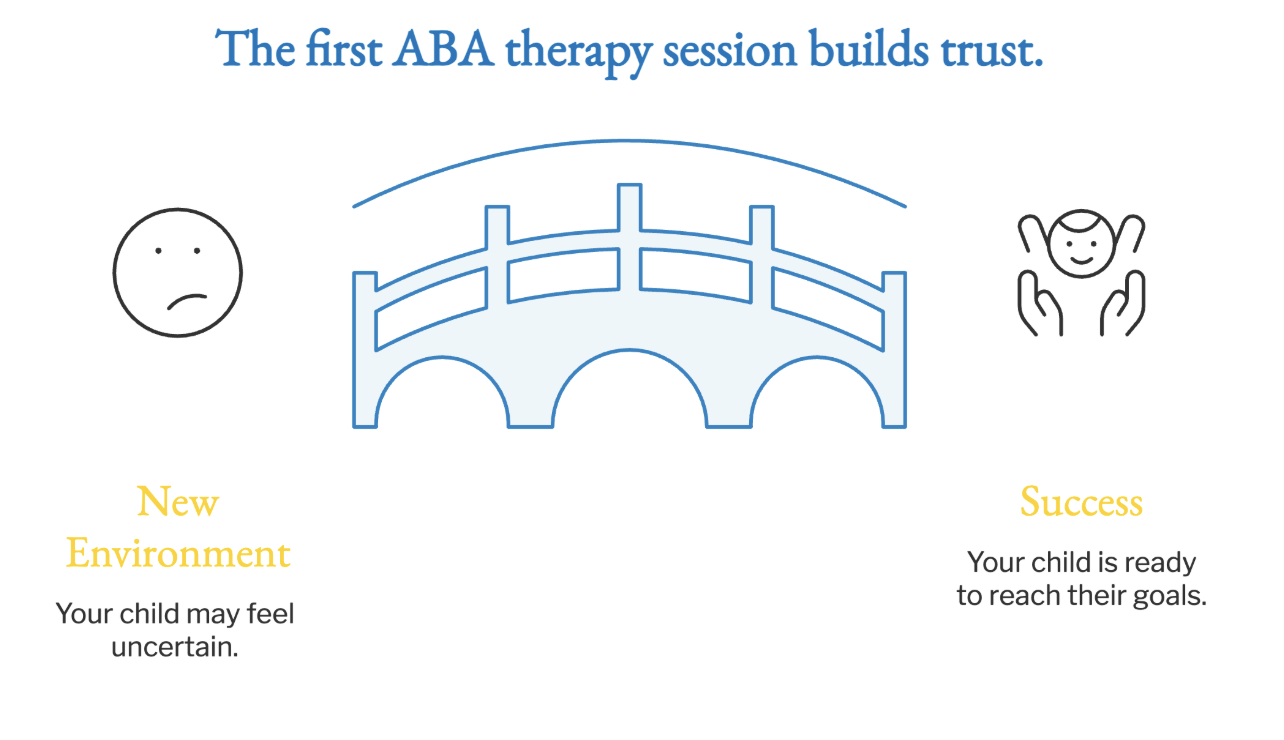
The first ABA session builds trust.
If you’re starting ABA therapy soon or you're still on the fence and gathering information, this guide will walk you through what a typical first ABA therapy session looks like. This way, you and your child can feel prepared, confident, and ready to take this important step together.
What Happens Before the First Session?
Before your child's first session with a Behavior Technician, a few important steps have typically already happened:
Intake and enrollment: You've completed paperwork, verified insurance, and officially enrolled in services.
Assessment: Your child's Board Certified Behavior Analyst (BCBA) has conducted a comprehensive assessment (often called a Functional Behavior Assessment, or FBA) to understand your child's current skills, challenges, and goals.
BCBA meeting: You've met with the BCBA to discuss your child's needs, your family's priorities, and the overall therapy plan.
BT assignment: A Behavior Technician has been assigned to work with your child. You may have already met them briefly, or the first session may be your introduction.
By the time the first session arrives, the clinical team already has a foundation of knowledge about your child. And think of the first session as a productive, yet small step. We won’t be doing “all the things” at once — we’ll begin building a relationship that will act as a cornerstone for your child’s personalized plan.
How to Prepare for the First Session at the Center
For center-based sessions:
Plan for the transition: If possible, visit the center beforehand so your child can see the space and meet some of the staff. Even a brief 10-minute tour can help reduce anxiety on the first day. If a pre-visit isn't possible, show your child photos of the center or talk about what the space looks like.
Bring a comfort item: If your child has a favorite stuffed animal, blanket, or small toy that helps them feel secure, bring it along. The center will have plenty of toys and materials, but having something familiar from home can ease the transition.
Pack essentials: Bring any items the center has requested. This could be extra clothes or pull-ups, depending on your child’s needs. Label everything with your child's name.
Prepare your child: You can prepare your child by saying something simple like, "We're going to a fun place today where you get to play!" Again, keep it positive and low-pressure.
How to Prepare for the First In-Home Session
For in-home sessions:
Prepare a space: Clear a comfortable area in your home where the session can take place, ideally somewhere with minimal distractions and enough space for movement and play. Don’t feel like you have to create the perfect, curated space. Just make it clean and safe.
Have some toys or materials ready: If your child has favorite toys, books, or activities, have them accessible. The BT will bring materials too, but having familiar items can help your child feel more comfortable.
Have essentials in arm’s reach: Make sure you have diapers or pull-ups, wipes, and preferred snacks or drinks on hand. Also, if your child uses any communication tools (picture cards, tablet with AAC app, etc.), have those easily accessible.
Prepare your child: You can prepare your child by saying something simple like, "Someone special is coming to play with you today!" Keep it positive and low-pressure.
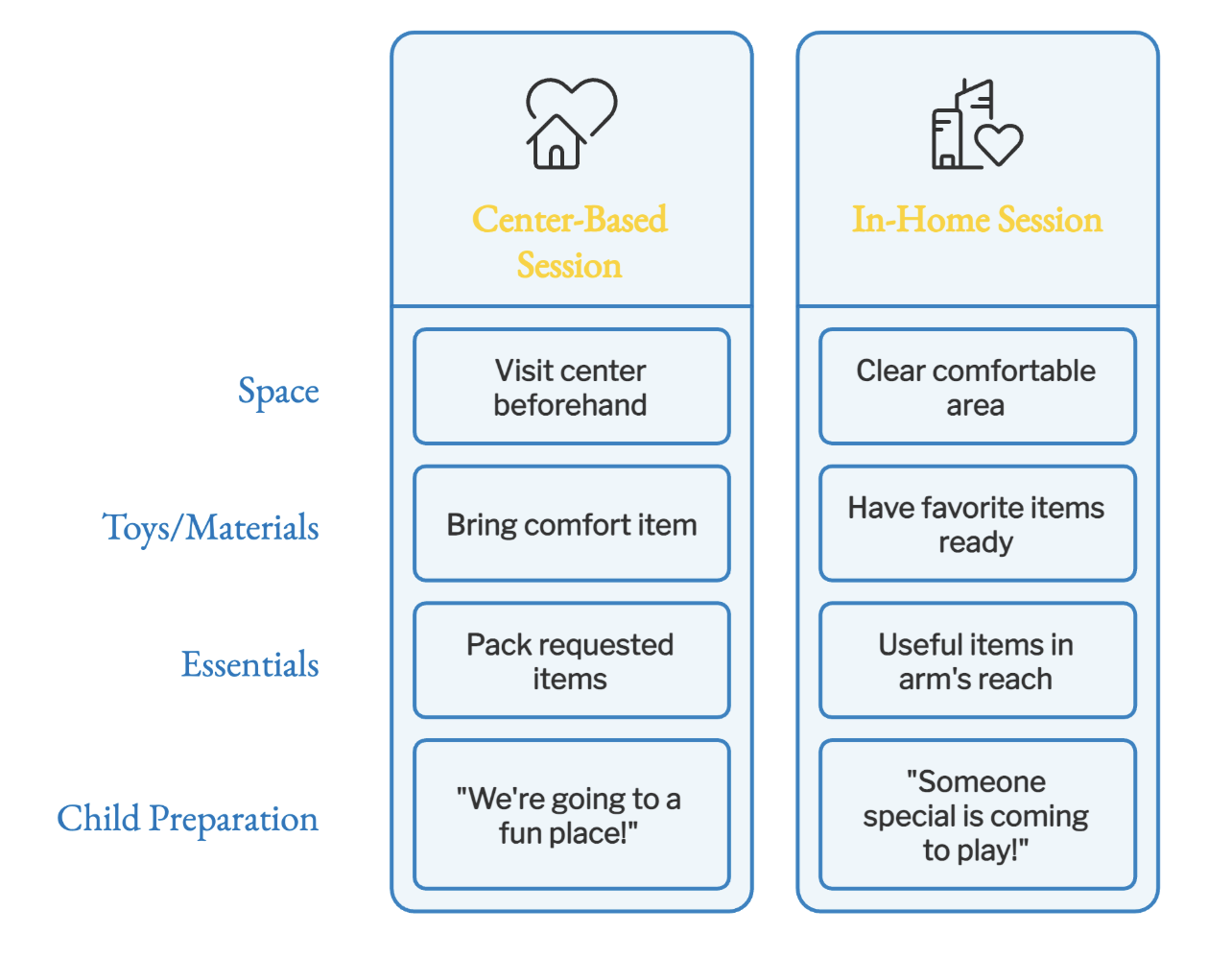
Prepare for your child’s first ABA session.
How ABA Sessions Are Typically Structured
Whether you’re doing ABA therapy at home or at the center, the ingredients of a session don’t change very much.
A typical session (either in-home or at the center) includes:
Warm-up or rapport-building: Playful interactions to help your child feel comfortable and engaged
Targeted skill practice: Working on specific goals from your child's therapy plan
Breaks and play: Built-in sensory breaks and play-based activities to keep sessions fun
Data collection: The BT tracks progress throughout the session via PrioraCare on their iPad
Wrap-up and debrief: A quick check-in with parents at the end
The First ABA Therapy Session is a Little Different
The main difference between a typical ABA session and the first ABA session is this: more emphasis on building rapport and relationships.
At Behavior Frontiers, we make this the most important aspect of our ABA therapy sessions. Because while ABA therapy is rooted in science and backed by data, without warmth, trust, and humanness, historically, ABA won’t work as effectively. So, the first step (or in other words, the first session) is an important, irreplaceable step that we cannot and will not skip.
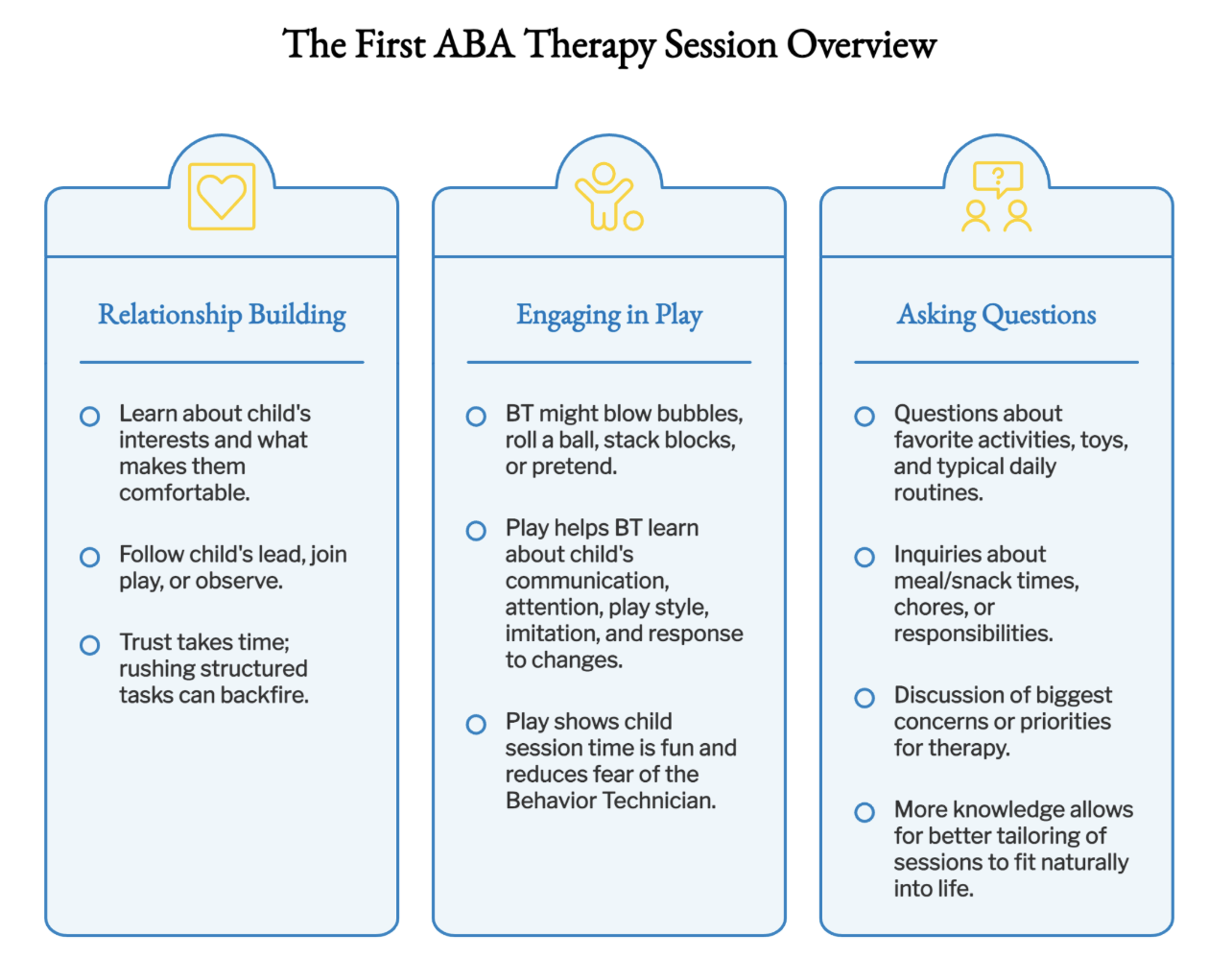
The first ABA therapy session overview.
Section 1 - Relationship Building
The BT will use the first session to learn about your child. Things like, what makes them smile, what they enjoy, and what helps them feel at ease. They might follow your child's lead, join in their play, or simply sit nearby and observe. There's no pressure, no demands, and no "work" quite yet.
This is intentional. Trust takes time, and rushing into structured tasks before a relationship is established can backfire. Your child’s BT knows this, and they'll take as much time as your child needs to warm up.
Section 2 - Engaging in Play
This will look like exactly what it sounds like: play. The BT might blow bubbles, roll a ball, stack blocks, or pretend with dolls. This part of the session is light, fun, and low-pressure.
But while it looks like simple play, it's also helping the BT learn a lot about your child.
They're observing:
How does your child communicate? (words, gestures, sounds)
Do they make eye contact or share attention?
How do they play with toys? (functional play, pretend play, exploration)
Do they imitate actions or sounds?
How do they respond to transitions or changes?
Play also shows your child that session time is fun and that they don't need to be wary of their Behavior Technician. They’ll begin to enjoy and look forward to the time they spend together.
Section 3 - Asking Questions
During or after the session, the BT will ask you questions to better understand your child and your family's routines. These questions might include:
What are your child's favorite activities, toys, or snacks?
What does a typical day look like in your home?
Are there specific meal or snack times we should work around?
Does your child have any chores or responsibilities?
What are your biggest concerns or priorities for therapy?
The more they know about your child's preferences and routines, the better they can tailor sessions to fit naturally into your life.
Your Role as a Parent During the First Session
One of the most common questions parents have is: What should I be doing during the session?
And honestly, there’s really no one right answer here. It depends on your child’s rhythms, where your session is (at home or the center), and what feels comfortable for you.
You can stay in the room and observe. Many parents like to watch the first session to see how their child responds. This is completely fine, and the BT will let you know if your presence seems to be helping or if your child might engage better with a little space.
You can step back and let the BT take the lead. Some children engage more readily when parents aren't directly involved. If that's the case, the BT may gently suggest you move to another part of the room or another room entirely.
You can participate if asked. Sometimes, especially with very young children or children who need a little extra support, the BT might ask you to join in the play to help your child feel more comfortable.
What Happens After the First Session?
At the end of the session, the BT will typically spend a few minutes debriefing with you. They might share:
What they observed about your child's skills and interests
How your child responded to the session
Any initial thoughts or observations
Your child’s BCBA will use data collected over the first several sessions to update your child’s ABA therapy plan to ensure it’s truly personalized and tailored to your child's unique needs and goals. You'll have opportunities to provide input, ask questions, and collaborate on what matters most to your family.
So, when do "regular" sessions with structured goals begin? This varies, but typically after a few rapport-building sessions, the BT will start introducing more structured skill-building activities. Having a gradual transition is often more natural and aligned with your child’s comfort level, especially if they’ve never experienced anything like ABA therapy before.
The First Session Won’t Be Perfect
The first session doesn't have to go perfectly. In fact, it rarely does.
Your child might be shy, anxious, or completely uninterested in engaging with the BT. They might be uncomfortable and cling to you. And that's okay.
Children will take time to warm up, are often skeptical of new people, and will probably need multiple sessions before they feel comfortable. Your child's response (whatever it is) gives the team valuable information about how to support them moving forward.
The First Session, The First Step
The first session is the first step toward ensuring their therapy plan is personalized and designed specifically for your child.
Over the next few sessions, the BT will continue gathering information about your child's skill levels, interests, and areas for growth. They'll share their observations with the BCBA, who will use that data (along with the initial assessment and your input) to confirm or adjust your child’s therapy plan.
This plan will outline:
Specific, measurable goals for your child
Strategies and teaching methods tailored to your child's learning style
How progress will be tracked and celebrated
At Behavior Frontiers, all of this is supported by our proprietary PrioraCare™ platform, which tracks progress in real time and allows clinicians to adjust strategies quickly based on what's working. You'll be kept informed every step of the way, and your voice will always be part of the conversation.
Ready to take the first step towards ABA therapy? Reach out to us to get started! After a brief intake, you'll be connected with a Board Certified Behavior Analyst (BCBA) to begin your child's ABA journey and build a growth plan tailored to their unique needs.