
What Autism Assessment Does My Child Need? What Every Parent Should Know

Lately, you may have found yourself watching your child a little more closely. Maybe certain milestones aren’t happening the way you expected, or you’ve noticed small things that give you pause. If you’re feeling unsure, concerned, or simply looking for answers, you’re not alone.
And now you're here, wondering:
Does my child have autism?
How do I find out?
What are the next steps?
All of these questions are completely normal because seeking an autism assessment can feel heavy and hard to navigate. However, taking this step is one of the most proactive, loving things you can do for your child. Because understanding your child's needs is the first step toward getting them the right support.
At Behavior Frontiers, we often work with families navigating this journey, and we're here to walk you through what the autism assessment process looks like, what to expect, and how to take that important first step.
Assessment: The First Step
Many parents hesitate to pursue an autism assessment because they're afraid of what a diagnosis might mean.
But think of it this way: a diagnosis is the key that unlocks support for your child. So, getting an assessment scheduled is the first step towards gaining the support they may need.
Early assessment and diagnosis matter because they:
Open the door to services: Many early intervention programs and therapies (like ABA) require a formal diagnosis for insurance coverage and eligibility.
Help you understand your child's needs: A diagnosis helps you make sense of behaviors that may have felt confusing or overwhelming before. And it guides you toward strategies that will help.
Allow for early intervention: Research shows that children who receive support early (especially before age 3) often make more significant progress. The earlier you know, the sooner you can act.
Empower you as a parent: Understanding your child's unique way of experiencing the world helps you advocate for them, communicate with educators and providers, and make informed decisions about their care.
A diagnosis is information, yes. But it’s also a force that guides you to the best ways to support your child.
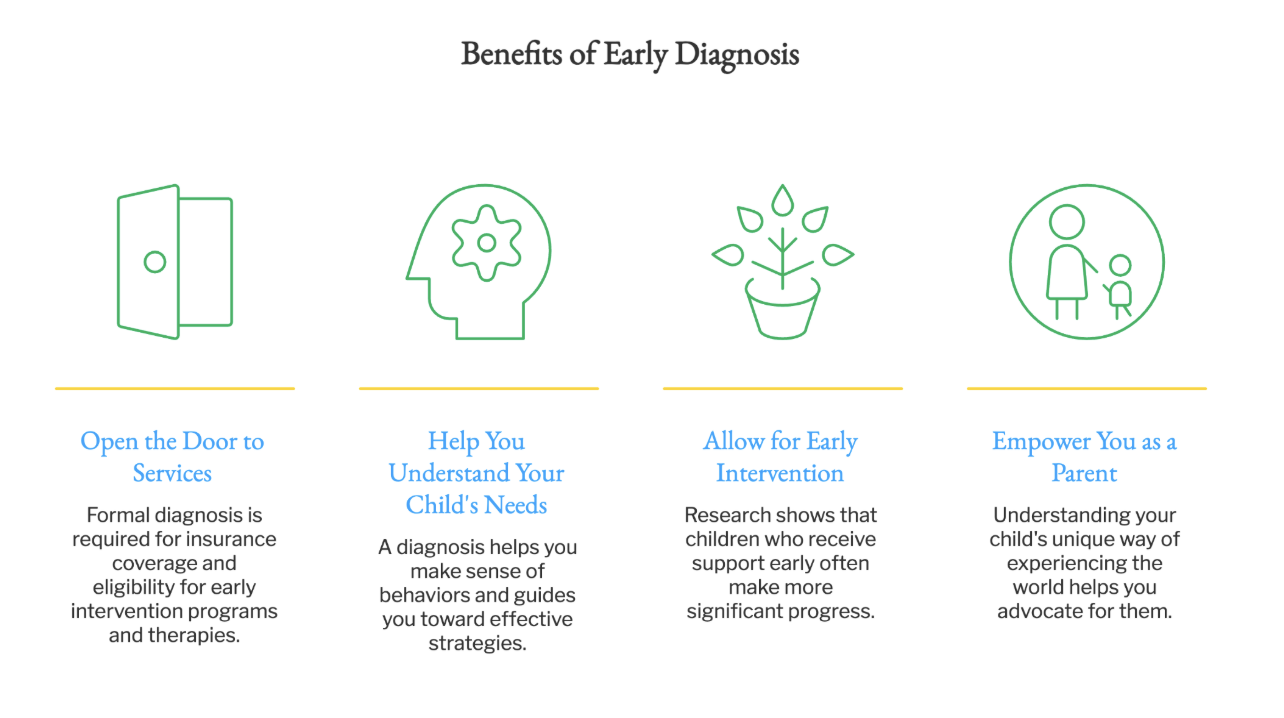
Benefits of early autism diagnosis.
What Is the ADOS Test?
One of the most widely used tools in autism assessment is the Autism Diagnostic Observation Schedule (ADOS). It's a standardized diagnostic tool designed to assess and identify autism by evaluating your child's social interactions, communication, and play in a structured environment.
The ADOS is considered the gold standard for autism diagnosis. It's reliable, research-backed, and widely trusted by clinicians and diagnosticians. It takes into account your child's developmental level and age, making it both flexible and effective for assessing children at different stages.
The assessment typically takes 45 minutes to an hour, depending on your child's age and needs. Afterward, the evaluator will meet with you to gather additional information about your child's behavior, development, and history.
Important note: ADOS results are one part of a broader autism diagnosis, meaning they don't stand alone. A full evaluation that leads to a formal diagnosis includes multiple sources of information, including parent interviews, developmental history, and sometimes additional assessments.
What Happens During the ADOS Test?
The ADOS involves structured, play-based activities designed to observe how your child interacts, communicates, and plays. This is never a pass/fail test. It’s treated as an observation tool that helps the evaluator understand your child's social and communication patterns.
This might sound formal, but the assessment is designed to feel comfortable and engaging for your child. The evaluator uses toys, games, and interactive scenarios to observe how your child responds in different situations.
The most recently updated ADOS test is the ADOS-2 autism assessment, which involves standardized scenarios in four different modules tailored to your child's age and language ability.
The evaluator chooses the module that best fits your child:
Module 1: For children with little to no speech (usually ages 12 months and up)
Module 2: For children with some speech but not yet conversational
Module 3: For children and adolescents who are verbally fluent
Module 4: For older adolescents and adults with strong verbal skills
During the assessment, the evaluator might engage your child in activities such as:
Creating a pretend birthday party using Play-Doh and a baby doll (to assess imaginative play)
Rolling a ball back and forth (to observe social reciprocity)
Playing with bubbles or wind-up toys (to see how your child shares attention and interest)
The evaluator will also observe other important behaviors, including:
Pointing and gesturing
Responding to their name
Eye contact and joint attention
Language and communication patterns
Repetitive or restricted behaviors
After the assessment, you'll receive a detailed report that explains the findings and helps guide your next steps.
Other Assessments Used in Autism Diagnosis
The ADOS is often used alongside other tools to create a complete picture. One common companion assessment is the Autism Diagnostic Interview-Revised (ADI-R), which involves structured interviews with parents to gather detailed information about the child's developmental history and current behaviors.
Together, the ADOS and ADI-R provide a comprehensive view of your child's strengths, challenges, and developmental patterns.
Understanding Screening vs. Diagnostic Tools
It's also helpful to understand the difference between screening tools and diagnostic assessments.
Screening tools are quick questionnaires that help identify whether further evaluation might be needed. They're often completed by parents at home or during pediatric well-child visits. These are preliminary tools—they don't diagnose autism, but they can raise red flags that warrant further assessment.
Diagnostic assessments (like the ADOS and ADI-R) are comprehensive evaluations conducted by trained professionals. These are what lead to a formal diagnosis.
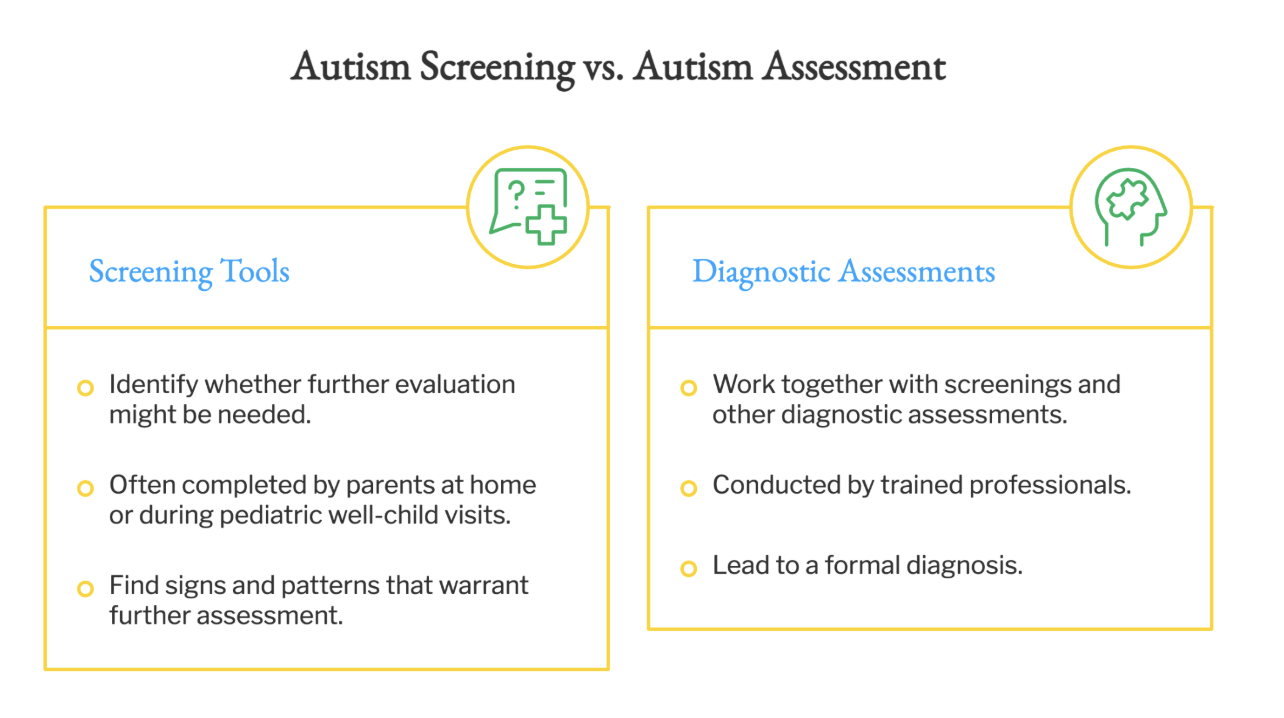
Comparing autism screening with autism assessment.
Here are some common screening tools you may encounter:
Modified Checklist for Autism in Toddlers, Revised (M-CHAT-R/F) – A free, parent-completed questionnaire for ages 16–30 months. It includes 20 questions about your child's behavior and can help you identify concerns to discuss with your pediatrician.
Social Attention and Communication Surveillance, Revised (SACS-R) and SACS-Preschool (SACS-PR) – Tools designed for ages 12–60 months, administered by trained professionals to identify early autism characteristics.
Social Challenges Screening Questionnaire (SCSQ) – A 15-question screener for school-aged children, designed for parents, educators, and medical professionals.
Autism Spectrum Quotient (AQ) Test – A self-administered questionnaire for adolescents and adults aged 16+ to measure autistic traits.
These tools can be helpful starting points, but they are not diagnostic. If screening results suggest autism, the next step is a comprehensive evaluation with a qualified diagnostician.
Who Administers Assessments?
Autism assessments are administered by trained professionals. They are typically psychologists, developmental pediatricians, or licensed diagnosticians who specialize in autism assessment. These professionals have extensive training in recognizing autism traits and interpreting assessment results.
At Behavior Frontiers, we do not directly provide diagnostic evaluations or diagnose autism. However, we do partner with qualified diagnosticians and psychologists across the country who can conduct comprehensive assessments, including the ADOS. If you're looking for an assessment and are ready to start ABA therapy with Behavior Frontiers following your diagnosis, we can connect you with a trusted diagnostician in your area in as little as 4 weeks.
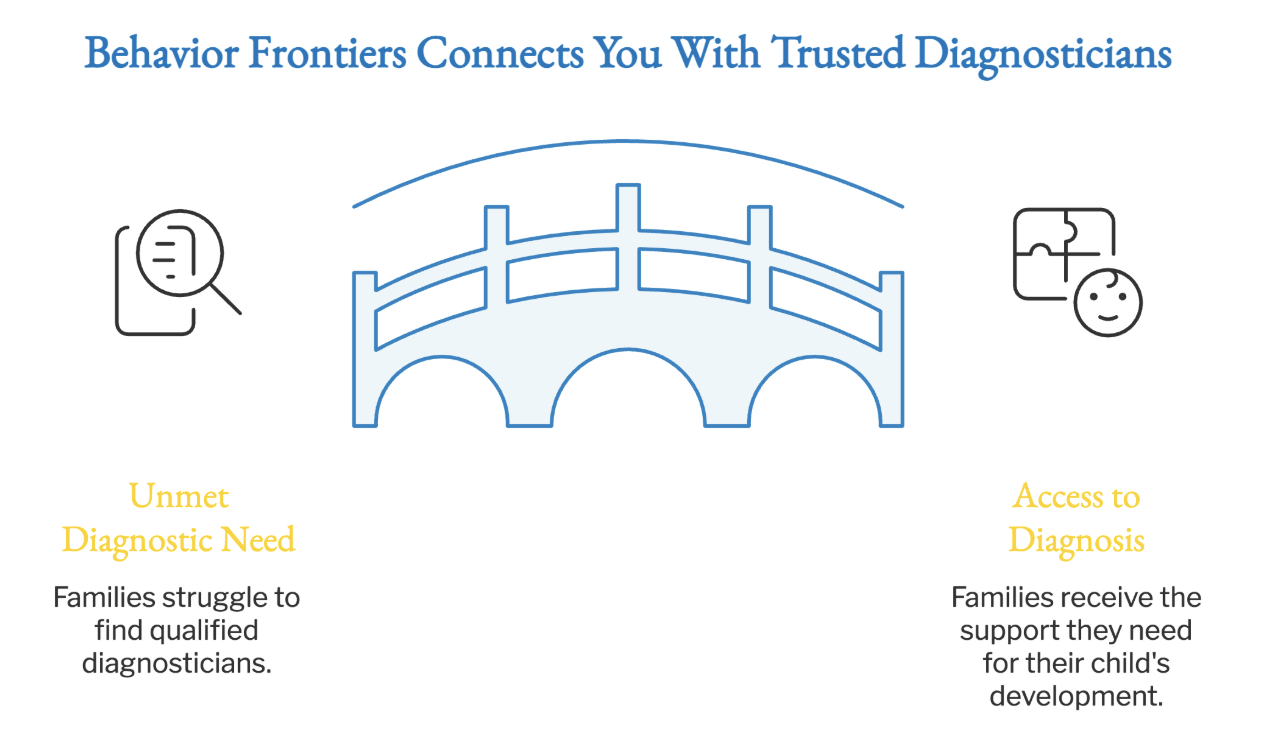
What to Expect During the Assessment Process
If you're preparing for your child's assessment, here's what you can expect:
Before the appointment: You may be asked to complete questionnaires about your child's development, behavior, and medical history. Gather any records from pediatricians, therapists, or educators that might be helpful.
During the assessment: The evaluator will interact with your child in a calm, structured way. Most children do well because the activities are play-based and engaging.
How long until results? This can vary, but if you connect with us to schedule an assessment, you’ll receive a comprehensive report in one week.
What Happens After the Assessment?
Once the assessment is complete, there are a few possible outcomes:
If your child receives an autism diagnosis:
You'll soon have access to early intervention services, ABA therapy, and other support through Behavior Frontiers.
You can begin working with the Behavior Frontiers team to create a comprehensive care plan.
At Behavior Frontiers, we're here to support you with personalized ABA therapy designed to help your child build communication, social, and daily living skills.
If your child does not receive a diagnosis:
The evaluator may recommend continued monitoring, especially if your child is very young.
They may suggest re-assessment in 6–12 months if developmental concerns persist.
Other diagnoses or supports (like speech therapy or occupational therapy) may still be appropriate.
Either way, the assessment gives you what you need: a path forward.
You Aren’t Walking Through Autism Assessments Alone
Feeling overwhelmed by all the information, assessments, and next steps is part of the process. It’s okay to name the feeling and be unsure of what to do.
But here's what we want you to know: seeking answers is a sign of strength.
You're taking action because you love your child and want to understand how to support them best. And no matter what the assessment shows, your child is still the same amazing person they were before, full of potential, deserving of love, and capable of growth.
A diagnosis doesn't define who your child is. It creates a roadmap to acquiring the support and tools they need to thrive at school, at home, in life, and beyond.
So, if you believe your child is showing signs of autism and you’re ready to start ABA therapy with Behavior Frontiers, contact us today to connect with one of our licensed diagnostician partners. We'll help you take that important first step toward understanding what your child needs.